Launch from Mars - How we ingnite rocket and do a same rocket launch like Earth as on the Mars
By Asif Iqbal Palash • •
A blueprint for building a launch-capable industrial civilization on Mars using robots, Martian resources and real engineering.
BOOK DESCRIPTION - Launch From Mars
Mars has always waited for us, silent beneath a thin sky of dust and iron. It is a world with no oceans, no forests, no wind soft enough to shape a leaf. Yet hidden inside its rocks, its frozen soil, and its rust-colored plains lies everything humanity needs to rise again. Launch From Mars explores the first real blueprint for creating a launch-capable civilization on another planet, one built from scratch, with nothing but robots, raw Martian minerals, and the fierce determination to return home.
This book follows the story of how a single nuclear reactor, carefully planted on the surface of Mars, becomes the heart of an entirely new industrial ecosystem. From that first pulse of power, robotic workers awaken and begin a sequence of construction unlike anything attempted on Earth. Iron is drawn from Martian regolith. Cables are manufactured from scratch. Factories grow from the dust, piece by piece. And gradually, through deliberate engineering steps, Mars begins to support not just life, but possibility: the ability to launch a rocket from its own soil.
But this is not a tale of fantasy. Every step in this journey is grounded in real physics, real chemistry, and real engineering. There are no magical technologies here, only what human ingenuity can genuinely achieve with existing or near-future tools. The path is slow, deliberate, and often fragile. Meteor strikes threaten progress. Power must be conserved. Robots must learn to repair each other. Yet with each challenge, the system grows stronger, more stable, more alive.
At its core, Launch From Mars asks a profound question:
Can we build a self-sustaining launch system on a planet where everything must be created from zero?
The answer unfolds through the logic of survival.
Start with power. Build iron. Make cables. Expand industry. Produce fuel. Assemble rockets. And finally, launch, not from Earth, but from a world that has become our partner rather than our destination.
This is the story of how humanity leaves Earth not once, but twice.
First by traveling to Mars.
And then, by learning how to rise from it.
Should not be an one way ticket to Mars, human life must return to The Earth
The base had grown quietly for months. What began as a single nuclear heartbeat humming beneath a thin blanket of Martian dust had expanded into a living cluster of metal, cables, furnaces, and machines. The first iron had been processed. The first cables had been drawn. Meteor shields, rough, uneven, but strong, had been raised like armor plates around the site. Nothing here was elegant. Everything was purposeful.
The robots worked with a steady patience that no human crew could match. They did not need rest or warmth or air. They only needed power, and the reactor gave it to them faithfully. As the facility expanded, the machines gained confidence, almost like a young colony learning how to walk. They repaired each other, replaced broken parts, updated their own routines, and cleared damaged sections after each dust storm. The more they built, the more capable they became.
And then the time arrived for the most important test of all: the launch.
The rocket standing on the pad was not enormous. It wasn’t meant to carry people or cargo or grand dreams. Its purpose was simpler and far more symbolic. Inside its small reinforced capsule lay a sealed container filled with processed Mars rock, iron, silica, and traces of metals refined by the robots themselves. It was a message in mineral form. A statement. A proof.
If this rocket reached Earth, if it pierced two atmospheres and crossed tens of millions of kilometers of emptiness, then humanity would know one thing with certainty:
Mars can send something back.
That single ability changes everything.
A planet from which nothing can leave is a prison.
A planet that can launch is a partner.
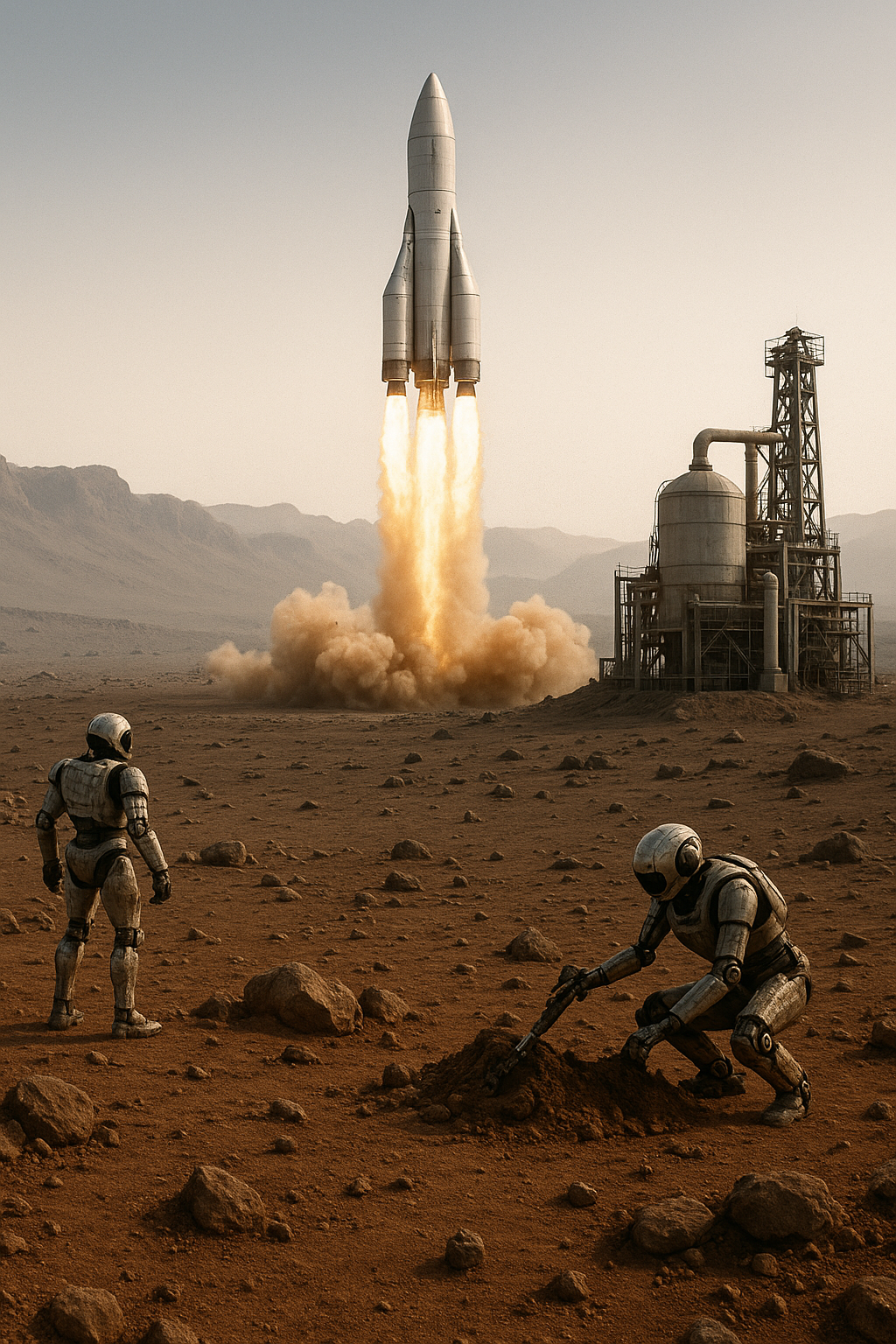
The robots gathered around the launch platform as the final checks rolled across the network. Lines glowed on their screens. Compressors breathed methane and oxygen into the rocket’s tanks. Sensors measured the vibration of the pad. The guidance array aligned itself toward the narrow corridor of sky that led home.
No human hand touched a single part of this sequence.
When the countdown reached zero, the surface of Mars trembled. Flames carved bright scars into the dusty air. The rocket rose with a force that felt ancient and new at the same time. For the first time in the history of Mars, a machine built on the planet was leaving the planet.
The robots tracked the ascent until it vanished into the thin sky. Then they returned to their work, because they had no need to celebrate. They had only one mission: to keep building.
Weeks later, when the capsule blazing with Martian dust entered Earth’s atmosphere, cameras caught it streaking across the dawn like a silent comet. Recovery crews found it intact, still warm from the long journey. Inside the capsule, beneath a small engraved plate stamped on Mars, lay the first rocks ever returned from another planet, not by astronauts, but by robots who had learned to build a launch system with nothing but dust and power.
That return sample was more than a souvenir.
It was reassurance.
It was evidence that Mars was no longer a remote dream.
It was a place that could speak back.

Comments
No approved comments yet.